Writing great content isn’t enough. To get noticed, your blog needs strategic SEO. This comprehensive blog SEO checklist walks you through the essential steps to optimise every blog post for search engines, while maintaining clarity, creativity, and connection with your audience.
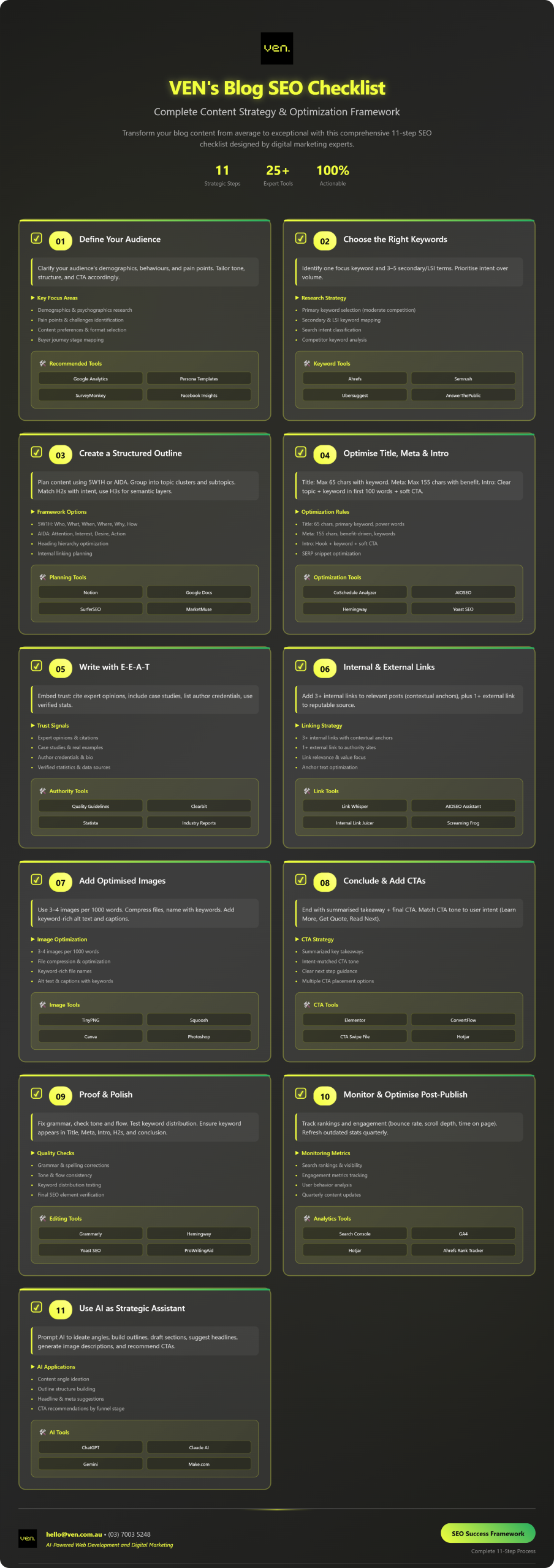
Blog SEO Checklist 2025 Overview
| Step | Detailed Action | Tools & Suggestions |
|---|---|---|
| 1. Define Your Audience | Clarify your audience’s demographics, behaviours, and pain points. Tailor tone, structure, and CTA accordingly. | Google Analytics, Customer Persona Templates |
| 2. Choose the Right Keywords | Identify one focus keyword and 3–5 secondary/LSI terms. Prioritise intent over volume. | Ahrefs, Semrush, Ubersuggest, AnswerThePublic |
| 3. Create a Structured Outline | Plan content using 5W1H or AIDA. Group into topic clusters and subtopics. Match H2s with intent, use H3s for semantic layers. | Notion, Google Docs, SurferSEO |
| 4. Optimise Title, Meta & Intro (Sapo) | – Title: Max 65 characters, contains keyword, uses power words – Meta: Max 155 characters, includes 1–2 keywords, clear benefit – Sapo: Clear topic intro + keyword in first 100 words + one soft CTA |
CoSchedule Headline Analyser, AIOSEO, Hemingway |
| 5. Write with E-E-A-T | Embed trust: cite expert opinions, include case studies, list author credentials, use verified stats. | Google Quality Rater Guidelines, Clearbit for author bios |
| 6. Internal & External Links | Add 3+ internal links to relevant posts (use contextual anchors), plus 1+ external link to reputable source. Avoid linking for the sake of SEO. | Link Whisper, AIOSEO Link Assistant |
| 7. Add Optimised Images | Use 3–4 images per 1000 words. Compress files, name with hyphenated keyword terms (e.g., seo-blog-checklist.jpg). Add keyword-rich alt text and captions. | TinyPNG, Squoosh, Canva, Photoshop Save for Web |
| 8. Conclude & Add CTAs | End with a summarised takeaway + final CTA. CTA tone should match user intent (e.g., Learn More, Get Quote, Read Next). | Elementor, ConvertFlow, CTA swipe file |
| 9. Proof & Polish | Fix grammar, check tone and flow, remove redundancy. Test keyword distribution with Ctrl + F. Ensure keyword appears in Title, Meta, Sapo, H2s, and conclusion. | Grammarly, Hemingway, Yoast SEO |
| 10. Monitor & Optimise Post‑Publish | Track rankings and engagement (bounce rate, scroll depth, time on page). Refresh outdated stats and links quarterly. | Google Search Console, GA4, Hotjar |
| 11. Use AI as a Strategic Content Assistant | Prompt AI to ideate content angles, build outlines, draft sections, suggest headlines, generate image descriptions, and recommend CTAs by funnel stage. | ChatGPT, Claude AI, Gemini, Grok, Make.com |
1. Define Your Audience
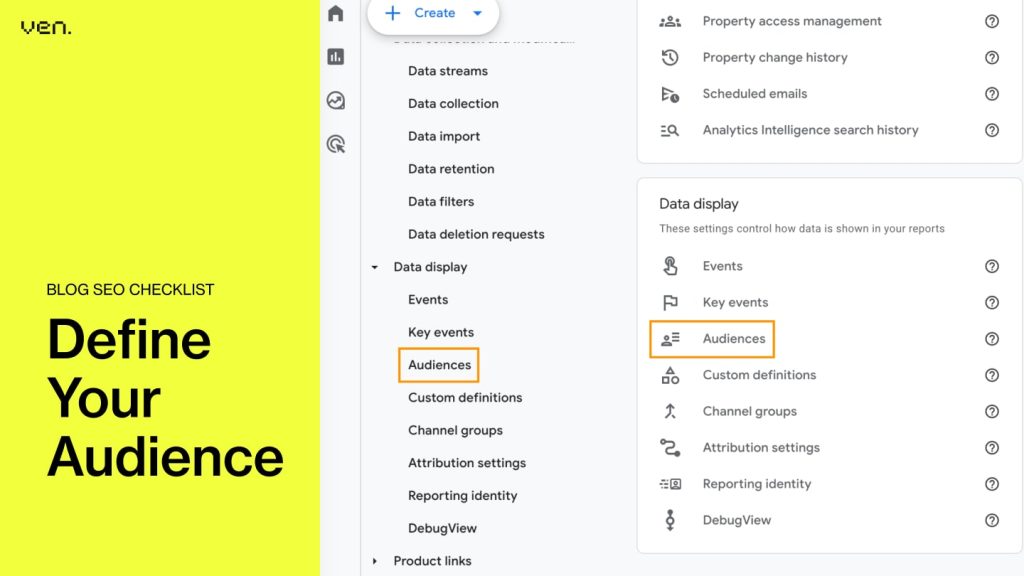
Before you dive into keywords, structure, or even your headline, pause and ask the most critical question in content SEO: who are you writing for?
Every piece of content exists to satisfy a human need; to answer a question, offer a solution, or inspire action. If you can’t clearly define which group of people will care about your topic, then you’ve already lost half the battle before even writing a word.
Start by identifying your audience’s core traits.
- Are you writing for tech-savvy Gen Zs, busy professionals, or homegrown entrepreneurs?
- Is your tone meant to sound premium and authoritative, or more casual and conversational?
- What action should the reader want to take after engaging with your post — share it, subscribe, or get in touch?
How AI Helps:
AI tools like ChatGPT or Claude can help analyse customer surveys, social comments, and CRM notes to identify persona patterns. You can also use AI to summarise key pain points from online reviews or competitor case studies, giving you a head start on defining your audience with data-backed insights.
At VEN, when we created content for a Melbourne boutique accountant, we identified two key personas: “Startup founders” and “small business owners expanding into e-commerce.” By tailoring tone, terminology and examples for each group, we wrote articles like “Bookkeeping Basics for Melbourne Startups” that saw a 45% increase in email sign-ups in just six weeks, not just web traffic but real conversions.
The takeaway is simple: write like you’re speaking directly to one person, not the entire internet. Define that person first, and every SEO decision you make after will be sharper, stronger, and more strategic.
2. Choose the Right Keywords
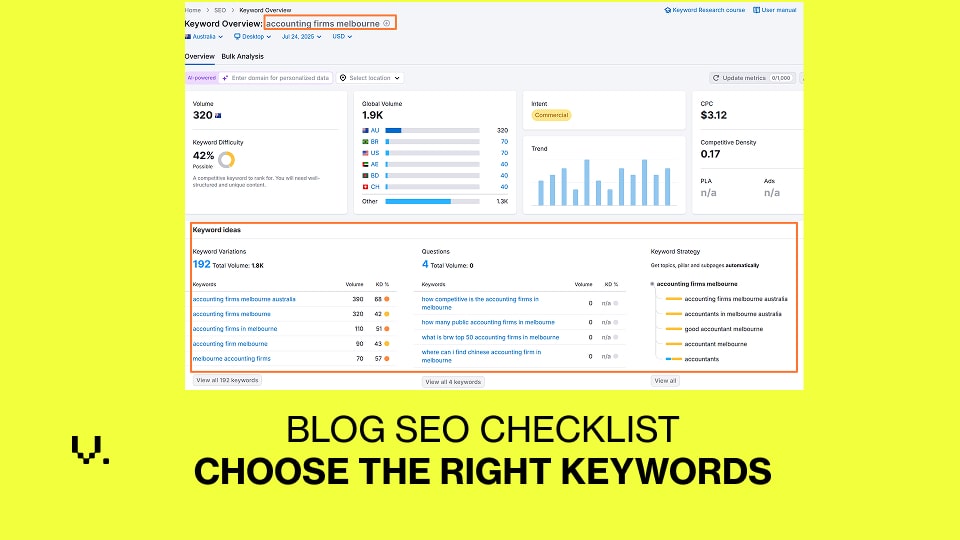
Identifying the right keywords is the backbone of any SEO strategy, but it’s not just about chasing high-volume terms. True impact comes from relevance and intent.
One of the most common issues content teams face is either choosing keywords too loosely (resulting in vague, unsearchable topics), or going overboard with too many keywords, which makes it nearly impossible to write naturally. Both lead to stalled content production and lacklustre results.
At VEN, we keep keyword strategy simple but focused. Each blog post starts with one clear primary keyword, the term most closely aligned with the topic’s search intent. Then we layer in 3 to 5 secondary keywords that support the main term. For higher-quality, long-form pieces, we also include LSI (Latent Semantic Indexing) or semantic keywords that broaden relevance without diluting focus.
How AI Helps:
AI can suggest keyword clusters based on semantic analysis or generate dozens of long-tail keyword variations from a single phrase. It can even simulate how your audience might search, helping uncover terms you may have overlooked. Combine this with tools like Ahrefs for validation.
This method helped a Melbourne-based wellness clinic refine its blog strategy. Instead of flooding posts with generic terms like “wellness tips,” we shifted to targeted combinations like “natural stress relief Melbourne” and “herbal sleep remedies VIC.” This keyword refinement led to a 58% increase in search impressions and helped their articles rank on page one for several long-tail terms within 6 weeks.
In short, choose smarter, not more. Let your keywords lead your intent, not overwhelm your writing.
3. Create a Structured Outline (Using Topic Clusters)
There’s no one-size-fits-all when it comes to blog structure, but without some kind of roadmap, your content can quickly lose direction. At VEN, we believe the best blog outlines strike a balance between SEO logic and human readability. That’s where strategic frameworks like Topic Clusters, AIDA, and 5W1H come in.
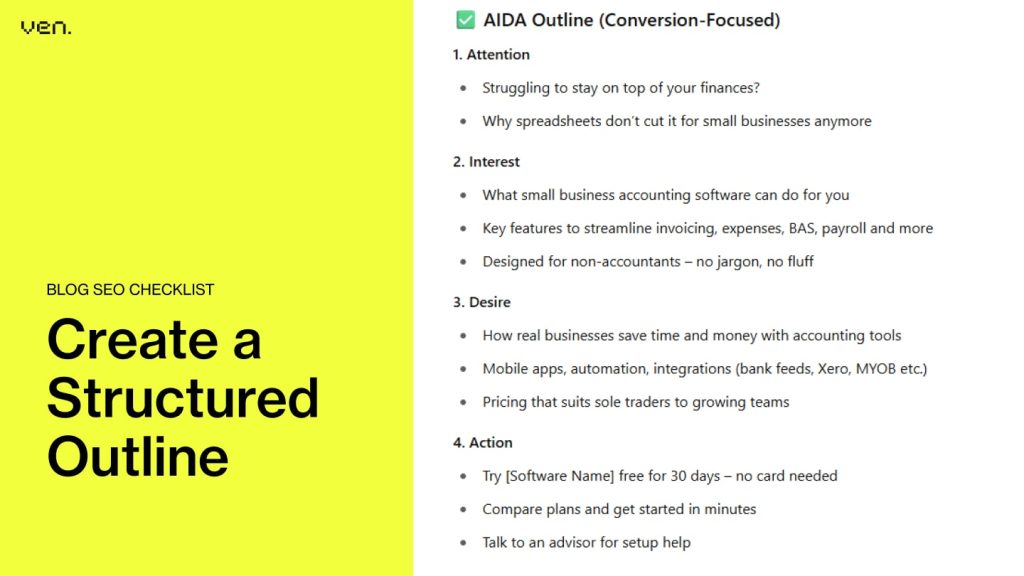
Topic Clusters involve creating a strong pillar article (a comprehensive, evergreen guide) and supporting it with multiple sub-topic posts that explore related questions. This not only improves SEO but builds a content ecosystem that keeps users engaged longer.
Depending on your goal, your outline may follow:
- AIDA (Attention, Interest, Desire, Action) for conversion-focused articles or landing-page SEO
- 5W1H (Who, What, When, Where, Why, How) for informative, big-picture content like service breakdowns or educational guides
How AI Helps:
Prompt AI to create an outline based on a primary keyword and your desired word count. You can ask it to use AIDA or 5W1H frameworks and ensure each heading matches a user query. Then, iterate or customise the outline before writing.
Take our client in Melbourne’s SaaS space: for their “CRM for Startups” pillar, we built out sub-articles like “Why Startups Need a CRM,” “Best CRM Features for Small Teams,” and “How to Migrate CRM Data Securely.” Each piece linked naturally to the next, improving internal SEO signals and helping us double their organic page views in 90 days.
The key is to avoid rigid templates. Use structure to support clarity — not stifle creativity. Start with a smart outline that mirrors how your audience searches and learns, and you’ll write with purpose every time.
4. Blog SEO Checklist Essentials: Title, Meta, Sapo & Full Article
Let’s be honest, writing content that ranks is one thing. Writing content that gets clicked? That’s another level entirely. Your title, meta description, and intro paragraph (or Sapo) are the trio that determine whether a reader even gives your blog a chance.
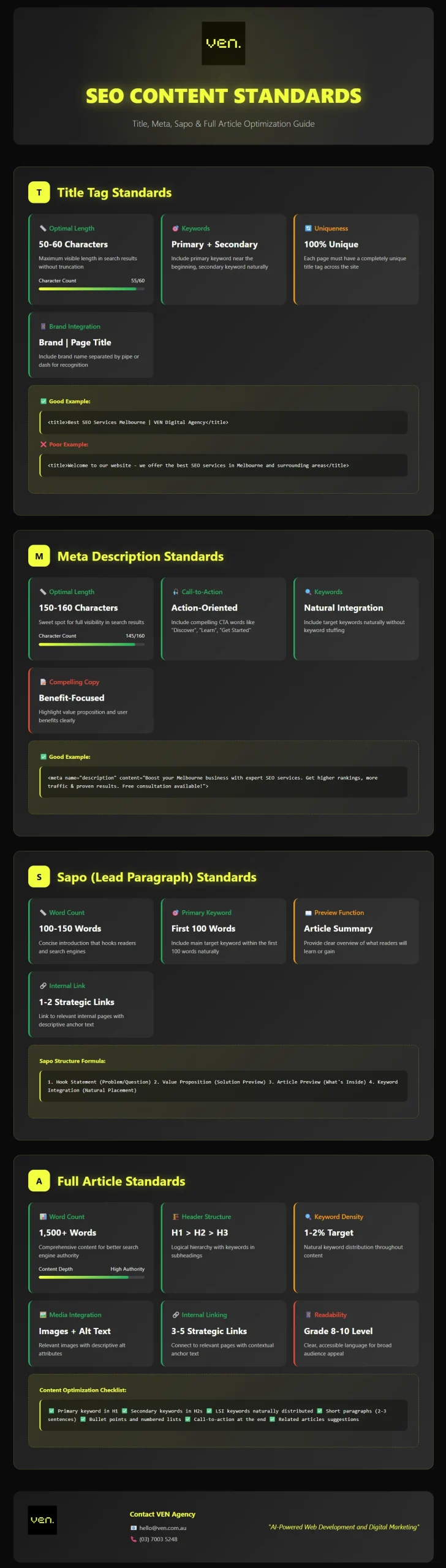
Surprisingly, our audits across hundreds of Melbourne-based sites reveal the same problem: missing or misused meta descriptions. Even worse, many brands rely on Google to auto-pull a random snippet from the intro, which tanks their click-through rate (CTR).
Here’s how to avoid that.
Meta Descriptions
A proper meta isn’t just a summary, it’s your pitch. Keep it under 160 characters. Include your focus keyword once or twice. Mention your brand if possible. Frame it as a question or a value promise. Make it speak directly to the reader’s pain point.
For example:
“Want to boost blog traffic without chasing trends? This SEO checklist reveals how Melbourne brands rank, and convert, organically.”
SEO Titles
This is your H1, and it matters. It should:
- Be under 65 characters
- Include the primary keyword
- Tease the value of the content (use numbers, urgency, or emotion)
- Avoid being too short or too vague
You don’t need separate SEO and display titles. Keep it consistent. If your title doesn’t spark interest, the rest of the content doesn’t stand a chance, especially on crowded SERPs.
The Sapo (Intro Paragraph)
This is the “hat” of your blog. It’s what keeps the reader from bouncing in 3 seconds. It should:
- Frame the problem
- Drop your main keyword naturally in the first few lines
- Hint at the solution
- End with a CTA like:
“Let’s break down the exact checklist we use at VEN to help Melbourne businesses double traffic without touching paid ads.”
How AI Helps:
Generate 5–10 meta descriptions or blog titles based on a keyword and tone guideline. You can also refine intros for readability or emotional pull. AI can A/B test potential titles by simulating user engagement triggers like curiosity or urgency.
For a Melbourne travel client, a well-crafted meta like:
“Looking for the best hidden laneways in Melbourne? Discover top cafés, street art and secret spots only locals know.”
Increased CTR by 25% and reduced bounce rate by 18%.
Structure Your Content with Headings That Make Google Happy
Here’s something many content teams overlook: Google doesn’t just read your content, it scans for structure. And that structure comes from your heading tags.
A strong blog post uses headings to guide both humans and search engines. Think of them as your content’s scaffolding. Each tag creates a visual and logical hierarchy:
- H1 – Your main title (used only once)
- H2 – Primary subheadings under the title
- H3 – Supporting points under each H2
- H4–H6 – Optional, for deeper layers of detail
At VEN, we structure outlines using 5W1H or AIDA, paired with strategic subtopics. Each H2 answers a key question; each H3 layers on clarity. And it works—especially when scaling across topic clusters.
How AI can help: Use AI to map out outlines before writing. A single prompt like, “Create an SEO-friendly outline for [keyword] using AIDA and include semantic subtopics,” gives you a head-start, especially helpful when producing pillar pages and support content in bulk.
Write SEO Content That Elevates Your Blog SEO Checklist Results
Once your structure is clear, it’s time to craft content that’s not only readable, but valuable. We judge writing quality at four levels:
- Level 1 – Factual, follows a basic structure
- Level 2 – Covers the topic completely, answers user intent
- Level 3 – Includes citations, expert quotes, data, and useful insights
- Level 4 – Adds a memorable voice, clever phrasing, and strong storytelling
Your mission: aim for Level 4 every time.
That means writing with substance, not fluff. Your primary keyword should appear naturally in strategic locations: title, meta, Sapo, headings, conclusion, and within the body. Use LSI and semantic terms in H3s to deepen relevance without repetition.
How AI can help: Treat AI like your first draft assistant. Feed it your outline and notes, then prompt it to write section-by-section, keeping tone and SEO in check. For example:
“Write 2 short paragraphs explaining ‘Why SEO content needs semantic keywords’ using an informative tone. Include one internal link and a Melbourne case study.”
5. Meet E‑E‑A‑T Standards in the Main Body
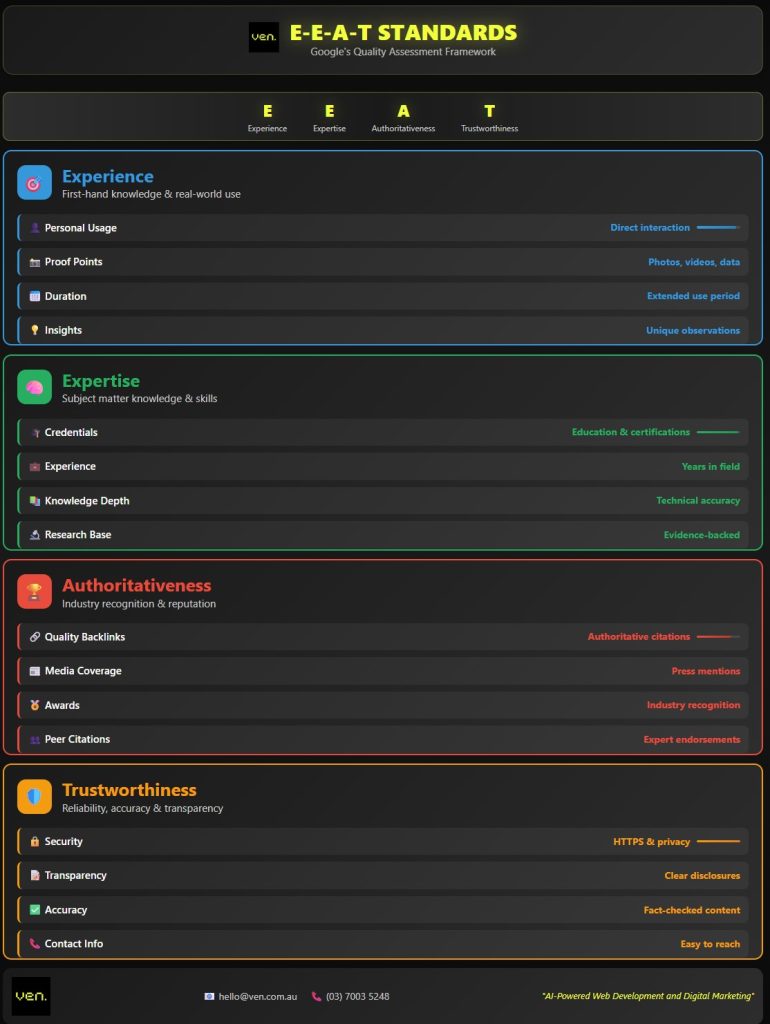
Google values content that demonstrates Experience, Expertise, Authoritativeness and Trustworthiness (E-E-A-T).
How AI Helps:
AI can organise research data into structured sections, reference government sources or industry leaders, and suggest ways to cite credentials. You provide real client experience, and AI weaves it into structured paragraphs that align with E‑E‑A‑T.
With a Melbourne financial adviser, we included client case studies, ATO links and CPA credentials, leading to 33% traffic growth and a 47% boost in bookings.
Moreover: E‑E‑A‑T (Experience, Expertise, Authoritativeness, Trustworthiness) and technical SEO go hand-in-hand. No matter how great your content is, poor site structure, slow loading times, or broken links will kill its visibility. Here is the Technical SEO Checklist that helps you track every aspect of SEO.
Smart web development ensures your site meets Google’s technical standards while supporting content that builds trust and authority. From schema markup to clean code, the foundation matters just as much as the message.
6. Strengthen Your Blog SEO Checklist with Strategic Linking
Internal links guide the reader and pass SEO value. External links show your sources and improve trust.
How AI Helps:
AI can crawl your blog archive and propose internal links by topic, relevance, and anchor text variation. With a simple table prompt, it can even create a link map for your next 10 blog posts based on content clusters.
Our Melbourne retail client used an internal linking map across blog posts, which increased click-throughs by 27%.
7. Add Images, Alt‑Text & Multimedia
Images do more than break up text; they boost clarity, engagement, and can even drive traffic. But only if you optimise them properly.
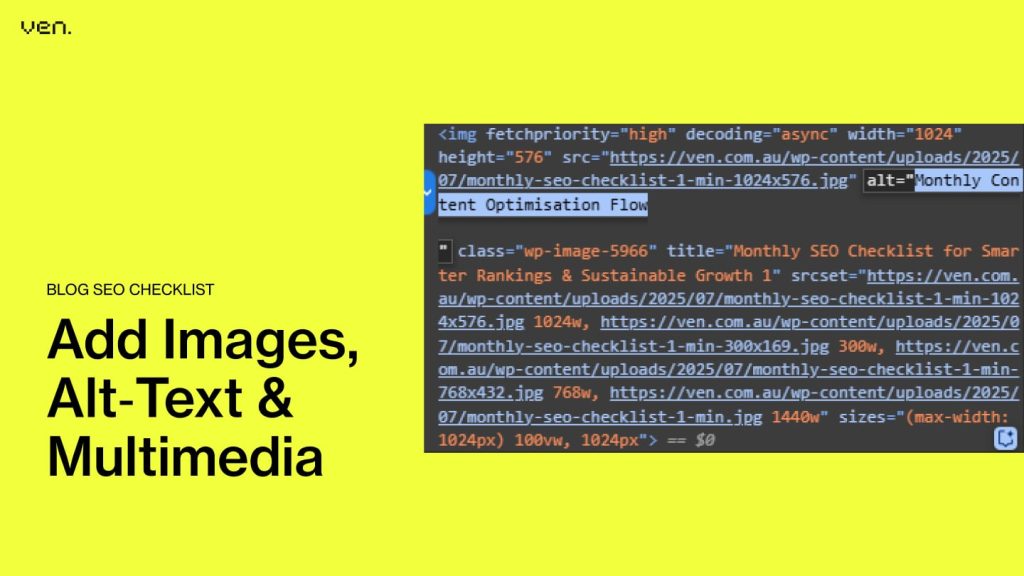
At VEN, we treat image SEO with the same importance as headings or internal links. Here’s how we approach it:
- Use high-quality, relevant visuals that match the content. Original photos, screenshots, or custom illustrations always perform better than stock images.
- Compress your images. JPEG is ideal for most use cases. PNG should be reserved for images needing transparency. Keep each file under 200KB to ensure fast page load.
- Size appropriately. While there’s no universal standard, 800px width with ratios like 4:3 or 16:9 generally work well across devices.
- Name your files descriptively using hyphenated keywords, no accents or spaces (e.g., seo-blog-outline-2025.jpg).
- Add alt text and captions. Alt attributes help Google understand the image, while captions improve on-page readability.
- Avoid using competitor-branded visuals, watermarked images, or anything that could risk copyright strikes.
- Match image quantity to content length. For every 1,000 words, we recommend 3 main visuals plus one thumbnail. Ideally, each H2 section should include at least one supporting image.
How AI Helps: AI tools like ChatGPT can suggest filenames, write alt text that naturally includes your keywords, or even describe what image fits each section based on your outline. If you’re using visual AIs like DALL·E or Midjourney, you can generate custom diagrams, charts, or illustrations tailored to each blog topic.
For one Melbourne-based gym client, we renamed images with SEO-friendly keywords, added rich alt text, and placed visuals strategically under key headings. The result? A 22% lift in Google Image traffic, all without spending a cent on ads.
8. Write a Strong Conclusion and CTAs
Guide Readers with Strong CTAs
SEO without action is just vanity. Your blog should guide readers toward a next step, whether that’s a service, product, or deeper piece of content.
CTAs (calls to action) should be subtle yet clear. We recommend placing 1–3 per article:
- After your opening insight (first H2)
- In the middle, where trust builds
- In the conclusion, when readiness peaks
Avoid generic CTAs like “Contact us today.” Instead, speak to the reader’s need:
“Need help building your SEO pillar strategy? Let’s map it out together. Book a 30-min strategy session.”
How AI can help:
Use AI to draft multiple CTA versions aligned with different user intents. Prompt example:
“Write a soft CTA for a reader just learning about SEO content. Then write a strong CTA for a reader ready to invest in blog optimisation services.”
Write a Conclusion That Concludes
Choose based on where they appear in the post, and your funnel goals.
Never leave your reader hanging. A strong conclusion doesn’t just wrap things up, it makes the final message stick.
Think of it as your last chance to deliver value and nudge the reader forward. At VEN, we close each blog with:
- A short recap of the key benefit
- Natural re-use of the main keyword
- A logical CTA or content bridge (internal link)
- Brand positioning or contact details (if relevant)
For example:
“By following these steps, you’re not just writing better blogs, you’re building long-term SEO momentum. Want to automate the process? Talk to our Melbourne team about AI-powered content ops.”
How AI can help:
Prompt it to summarise the article’s key takeaways using your brand tone. Then have it generate 2–3 CTA options for the final paragraph. This cuts decision-making time and helps refine closing copy that converts.
9. Proof, Polish & Optimise Before You Hit Publish
No matter how well-written your blog is, it’s rarely perfect on the first go. That’s why editing is essential, not optional.
Put yourself in your reader’s shoes: you’re halfway through an insightful post and suddenly… a typo, a missing word, or a formatting glitch breaks the flow. Momentum lost. Trust chipped.
Before publishing, double-check for:
- Typos and grammar errors
- Keyword usage (is it natural and evenly distributed?)
- Heading consistency
- Internal link accuracy
- Tone alignment with your brand voice
A quick Ctrl + F lets you track your main keyword. If it appears too little, find logical spots to include it. If it’s everywhere, trim it down. Aim for balance, not bloat.
How AI Helps: AI editing assistants like Grammarly, Hemingway, and Yoast SEO can spot issues humans miss, from sentence complexity to missed alt text. You can also prompt ChatGPT with:
“Review this blog for tone, grammar, and SEO keyword flow. Recommend better CTAs and flag repetition.”
Better still, ask it to tailor CTA suggestions by funnel stage or persona. For instance:
- “First-time reader? Here’s a guide to help you get started.”
- “Ready to scale? Book a content consultation now.”
One of our Melbourne SaaS clients saw a 15% lift in organic traffic just by running every blog through this final AI-polish process. Sometimes, great content becomes exceptional with just one more pass.
10. Publish, Monitor & Update
SEO isn’t a one-time job. Track performance, adjust strategy, and update outdated content regularly.
How AI Helps:
Use tools like Grammarly, Hemingway, or GPT to scan for grammar issues, sentence complexity, and tone mismatch. You can also ask AI to rewrite passive sentences or improve flow while keeping your brand voice intact.
A quarterly refresh of our Melbourne legal client’s articles kept rankings healthy and re-energised Google visibility, driving up form submissions month over month.
Final Notes: What to Keep in Mind When Writing SEO Blog Content
Writing SEO content isn’t just about following a checklist; it’s also about awareness, flexibility, and clarity. Here are a few important principles to keep in mind throughout the writing process:
Keep Sentences Short and Sharp
One of the most common issues with SEO writing? Overly long sentences that exhaust the reader. SEO writing prioritises clarity and digestibility. That means:
- Use shorter sentences and break down complex thoughts
- Avoid large, intimidating blocks of text.
- Use paragraph spacing wisely so your content is easy on the eye.s
Let’s be real, many SEO blogs sound the same. If your article feels like a rehash of every other post on the internet, readers (and Google) will disengage. Instead, focus on writing content that is clear, direct, and genuinely helpful.
Avoid Regional Slang or Localised Language
In a diverse market like Australia, and especially if you’re targeting beyond one specific location, avoid using niche, regional expressions that may confuse readers outside your area.
Your content needs to be accessible and relevant to a wide audience. That doesn’t mean stripping out all personality. It means prioritising clarity over local jargon so your message lands consistently with every reader, from Melbourne to Perth.
Don’t Lose Focus: No “Elephant Head, Mouse Tail”
Ever started reading a blog about one thing… and ended up somewhere completely different? That’s what we call an “elephant head, mouse tail” post. Great intro, confusing conclusion.
To avoid this:
- Stay aligned with your original topic
- Don’t veer off into unrelated tangents.
- Make sure every section contributes to solving the reader’s core question.
Google penalises content that lacks cohesion, and so do readers. A focused blog performs better, converts higher, and builds more trust.
Structure Isn’t Everything, Be Flexible
SEO best practices are important, but don’t let them box you in. Great content balances structure with storytelling, creativity with clarity.
Sure, follow the technical rules: use keywords, apply headings, optimise images. But also give yourself room to inject opinion, voice, and emotional intelligence. The key is balance.
For example, if you’re writing about how to choose an SEO agency, it’s OK to share your agency’s real experience with Melbourne-based clients, as long as it ties into the topic and adds value.
To see how we've applied these strategies in practice, check out our Postr case study.
Final Thought
Writing SEO content isn’t complicated, but it does require intention. Start with research, create a clear plan, and write with the reader in mind. Follow the steps in this checklist, and you’ll not only write SEO-friendly blogs, you’ll write better blogs, full stop.